
IN THE HEART OF a quaint, close-knit town nestled between rolling hills and lush forests, stood Helter Skelter. It was not just any bar but a sanctuary for the rebellious souls, echoing with the gritty sounds of punk rock and the raw energy of metal bands. Joe Boyle, with his wild mane of jet-black hair and a tattooed canvas of stories on his skin, was the pulse behind it all.
Joe was more than just the owner of Helter Skelter; he was the lead singer of local metal bands Mugly and RU486, and he ran a bustling tattoo shop next door. His life was a blend of ink, adrenaline-pumping music, and the camaraderie of misfits who found solace within the walls of his establishments.
However, controversy struck when a local TV station aired a segment about the community’s backlash against Helter Skelter’s logo—a bold emblem featuring Charles Manson. Outrage rippled through the town, fueled by the conservative voices of the religious community. Protesters gathered outside the bar, demanding its closure, while patrons and friends of Joe stood by him, defending the freedom of expression that Helter Skelter symbolized.
Amidst mounting pressure and a dwindling patronage, Joe faced a harsh reality: bankruptcy loomed over both his bar and tattoo shop. The once vibrant hub of music and art now faced closure, threatening to silence the very heartbeat of the town’s alternative scene.
In a daring move, Joe devised a plan that would shock the town to its core. One stormy night, amidst thunder and pouring rain, Helter Skelter and Joe Boyle became the headlines of the local news once more—but this time with a different story. A tragic fire had consumed the bar and tattoo shop, leaving behind only ashes and unanswered questions.
The town mourned the loss of Joe Boyle, the larger-than-life figure who had shaped their nights with music and ink. Memorials sprang up outside the charred remains of Helter Skelter, adorned with flowers and notes of gratitude from those whose lives Joe had touched.
Yet, in a small cabin deep in the woods, Joe Boyle quietly watched the news coverage unfold. He had staged his own death, escaping the crushing weight of debt and controversy. With a heavy heart but a determination to start anew, he shed his persona as Joe Boyle and embraced a new identity in solitude.
Months passed, and the town began to heal from the loss of Helter Skelter and its enigmatic owner. Rumors whispered of sightings—Joe Boyle spotted in distant towns, his tattoos hidden beneath plain clothes. Some believed he had found peace; others speculated he was plotting his return…
THAT ENTIRE NARRATIVE—everything you just read, the photo at the start of this article and even this month’s cover art—is completely made up, generated entirely by an artificial intelligence program.
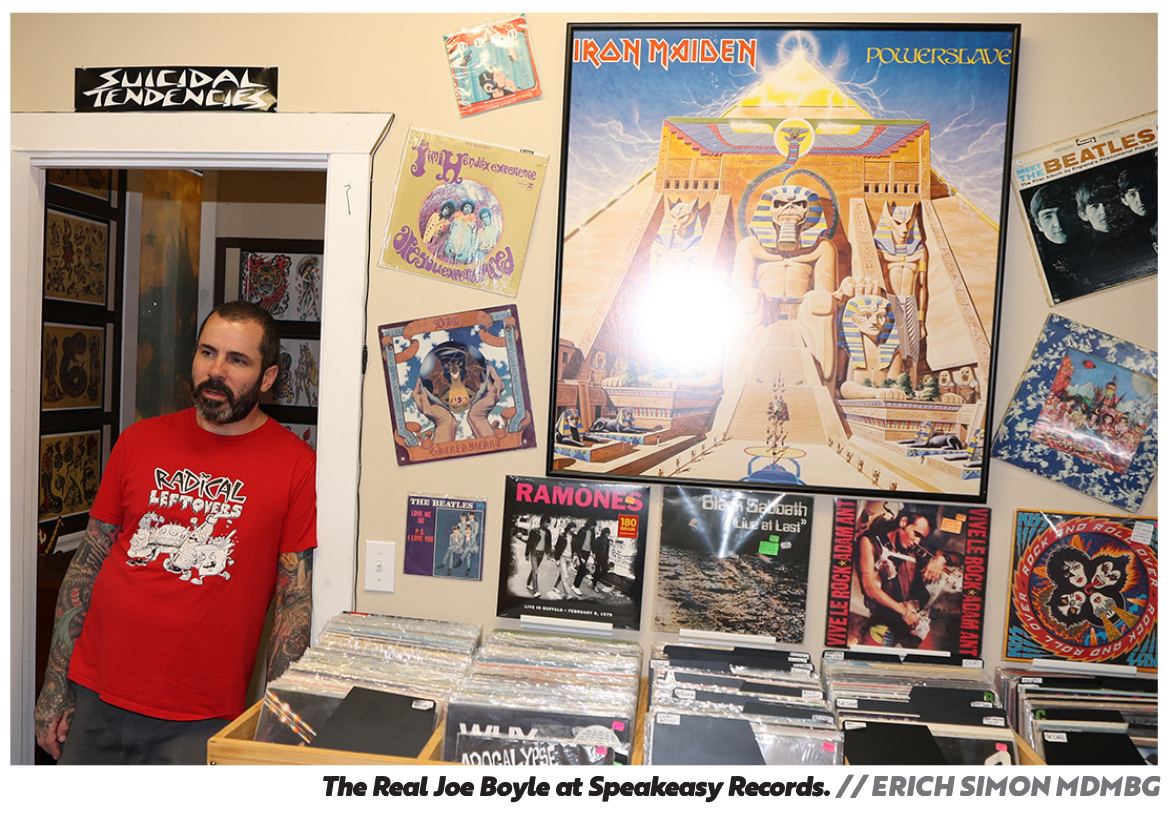
Bored one day, I shoved some notes from an interview with the local tattoo artist, record seller, former punk rock frontman and local music venue owner into the program while I was sitting in a shed in the middle of nowhere, many miles away from any other human beings.
I’d been reading ‘The Walrus Was Paul’—a book from the late-90’s by R. Gary Patterson about the 1960’s conspiracy theory and urban legend surrounding The Beatles, which suggests that Paul McCartney had died in a car crash amidst the height of the band’s fame and was replaced by a lookalike while the band scattered death clues into their lyrics and album artwork from that point forward.
The conspiracy became a worldwide phenomenon and is recalled to this day as ‘The Greatest Hoax in Rock & Roll History.’
Patterson’s book was one of the few concrete things that came out of the 14-hour bender of an interview I’d had with Joe. It showed up at my house a few days later. It was so important, apparently, I had ordered two copies. After reading the book, I thought it would be funny to tell Joe’s story through the lens of the infamous conspiracy.
He and I have been mistaken for look-a-likes on more than one occasion. The Beatles are one of his favorite bands. And his favorite Beatles’ song is ‘Revolution 9.’
But the idea of creating this conspiracy through artificial intelligence turned out to be more terrifying than anything. Not to mention, Joe’s debaucherous real-life story is actually, in my opinion, more interesting than the sensational story whipped up by AI bots.
The punk rock club part was true.
Joe did own a bar called Helter Skelter in Poulsbo. He built the bar off the back of his tattoo shop because he wanted a place where he could host and see the kind of bands that he wanted to see. And, the Helter Skelter was featured on King 5 News when conservative and religious people in the community took issue with the image of Charles Manson displayed prominently in the establishment’s logo and road signs.
But there was no fire. There was no vigil. And Joe didn’t fake his death.
He did partially retire, though he kept tattooing, after that building fell into bankruptcy, he said. He also was the singer of local hardcore band Mugly and RU-486, and I’m sure if you dove deep enough into the lyrics of either of those bands, diver beware, you will almost certainly find something that could be misconstrued as a death clue, or worse. He also runs a secret punk-and-metal-centric record store out of the back room of his current shop—which you won’t find on the internet because it’s only advertised by word-of-mouth—called Speakeasy Records.
The artificially generated story—in addition to being complete fabrication and misinformation—doesn’t tell us any of the most interesting details about Joe the person. The kid who was abused from a young age but stood up to his abuser. The teenager that would sneak out of his mom’s house and hitchhike from Seabeck in the late-80s to go to shows at the historic Bremerton rock club Natasha’s. He and his friends’ dumb idea of breaking into and trying to rob a laundromat which would land him time in jail as a teen. The ‘Kitchen Magician’ who would tattoo kids in kitchens and bathrooms at punk rock parties…
Granted, none of that stuff about Joe was on the internet. Almost all of those things happened before the internet as we know it existed. So the artificially generated software would have no way of knowing any of that, unless, of course, I would have provided it with that information.
With trepidation, I fed the thing three sentences.
Even that left me feeling conflicted, feeling like I was contributing to what could potentially be used as a dangerous tool. But that’s not exactly how it works. The machine is already out there digitally feeding on things. The Center for Investigative Reporting is currently suing one of the big AI corporations in federal court for copyright infringement. There’ve been reports of entirely AI generated community newspapers surfacing.
Even setting aside concerns about jobs and pay for writers, artists and creatives, setting aside the debate over the importance of pure human artistic creation, the convenience, the doomsday stuff about sentient robots taking over the world… look how easy it was to create a completely made up but potentially believable conspiracy theory.
It took less than ten minutes. In another ten-to-fifteen, I could’ve generated a photo and posted the story online and begun to spread the rumor through social media… But I was just doing it because I thought it’d be fun. It took me about an hour to write these last 600 words.
Not as funny as I thought it would be. // BILL MAN


